Metaware platform informatie

Metaware management system platform

Your quality system (now: management system) has been around since the 1990s. First as a paper manual for all department managers, much too often in too much detail. All activities had been recorded. Later they became digital PDF documents on the central disk. The authors had the Word documents and they created the PDFs. But still everything in too much detail. Risk-based targeting became the new approach. If you know where your risks lie, what your goals are and how you perform, you have focus. You can focus on the important things and leave out unnecessary ballast in your described management system, the old 'manual'.

With our long-term experience we have developed a management system platform, consisting of building blocks that can be used several times for different subjects. The higher the maturity stage of your own organization, the more building blocks you use. What used to be your (quality) manual is now a management system platform. More extensive: quality, safety, environment, information security, .. It is a prepared environment for the described processes with control measures, all operational workflow processes and last but not least the performance dashboard.


Management system - the maturity stages

From a bird eyes view, the stages from a 'manual' to a management system can be described in a number of steps:

  1. Ad hoc
    The understanding of quality management is limited. Process quality control is fragmented and issues are widely ignored. In terms of quality, there is a lot of ignorance and there is a belief that all is well. Formally there are no responsibilities and no accountability is made. Documentation of processes and working methods is limited and often outdated. Communication by e-mail and access to quality data and documentation is difficult.
    Tooling: We have already passed this stage.
     
  2. Reactive
    Besides the quality manager, only a limited number of people are involved in quality management. Quality data is collected on a limited basis, usually in separate spreadsheets. Users wait for problems to arise and then respond. Important quality problems are recorded, but not yet sufficiently analyzed to prevent recurrence. There is no integration yet.
    Tooling: A simple quality system for a limited number of people
     
  3. Managed
    Quality management is important throughout the organization, not just for the quality manager. Audits and controls are performed regularly. KPI's have been entered and this is followed. Ownership and responsibilities have been established.
    Tooling: Version management active, revision rolled out, navigation structures, audit system, registration, checklist ISO9001
     
  4. Proactive
    Quality data is available and accessible throughout the organization. Working methods are up-to-date and documented in a practical way and also accessible throughout the organization. Problems have been recognized and are being analysed. Actions are identified and executed to prevent recurrence.
    Tooling: Monitoring usemanagement system, reports; incident – > problem, 5Ws / 8D, risk process, various workflows for checklists, assessments, approvals
     
  5. Integrated and optimalized
    Focus is on quality management and a value within the organization. Full process integration supports proactive, risk-based quality decisions. Quality data is correlated with each other, if necessary with artificial intelligence. Collaboration is the key to success to leverage positive business and customer outcomes.
    Tooling: Integrated environment, knowledge base, risk analysis in relevant places/activities, risk carousel, quality calendar, FOBO analyses, dashboardsconcept quality system


Functionalities

A management system has a wide scope: the description of the processes versus the operational implementation. In fact the well-known slogan: 'Say what you do and do what you say.' A management system is therefore made up of various components: the descriptive part with document management and references to required standard items, the risk overview including risk treatment plan and further all related control processes (handling non-conformities, audits, complaints procedure, check operational excellence, ..).

An overview of 'standard' functionalities of a mature management system:

Navigation / search
  • Navigation / Search
  • Index of all documents
  • Overviews per function, process, standard item, ..
  • My documents, with which I have something to do
  • Last consulted by me
  • Trending documents within the organization
  • Recently searched within the organization
  • Full text search with filtering and search suggestions
Workflow control
  • Workflow Processes for Review, Authorization, Change
  • Self-definable workflow if necessary
  • Read confirmation if registration is important (e.g. safety instructions)
  • Quality calendar to structure activities
Risk based
  • Workflow control
  • Threat overview, risks with classification
  • Risk Mitigation Controls
  • Effectiveness assessment of operational measures
Integration
  • Bringing together 'say what you do' and 'do what you say'
  • Documentation and registration in one
  • One platform as access, but linked with other environments
  • Access from various devices: desktop, tablet, mobile
Expandable
  • Self-definable forms
  • Multiple applications within the same platform
  • For every work area, activity and own working environment
Monitoring
  • Views per document, per type, per period
  • Not found, but what has been searched for
  • Documents never used
  • Know what is being looked at
  • Self-definable graphs
  • Personalized widgets
  • Register weaknesses and specifically monitor them
Chain / Mobile
  • For customers who have to 'watch'
  • For subcontractors who need to read instructions (mandatory)
  • Share corporate documents
  • At the project location, on your phone
  • At the client's bedside, on your tablet
AI ready
  • APIs to unlock data to your own AI environment
  • Control framework for AI-enabled context
  • GapFit, audit readiness analyses

AI-ready = Context

A successful application of artificial intelligence (AI) within digital management systems starts with reliable, structured and coherent management information. A clear governance structure establishes responsibilities, powers and decision-making and thus forms the basis for who has to do what and when. A fully developed framework of standards, based on relevant laws and regulations and standards such as ISO 9001, ISO 27001 and the EU AI Act (cybersecurity law), makes requirements transparent and verifiable. By integrally connecting risks, threats and opportunities with processes, objectives and compliance obligations, the context is created that AI needs to recognize relevant connections and generate meaningful reports (audit-ready or not).

An integrated control framework brings together management objectives, internal controls and standard requirements in one digital management system. Directly linked mitigation measures make it clear how risks are managed, which actions are necessary and who is responsible for them. Up-to-date insight into the implementation status of actions and measures enables AI to analyze progress, flag deviations and support improvements.

An auditable compliance structure, with demonstrable evidence, traceable information, and recorded approvals, ensures that AI analytics remain auditable and support human decision-making. With this structured context, digital management systems can grow from AI-assisted knowledge disclosure to intelligent process execution and ultimately continuous compliance monitoring.

AI readiness therefore requires not only technology, but above all an integrated digital management system with a clear context in which governance, risks, control measures and compliance come together as a reliable basis for AI-driven quality management.
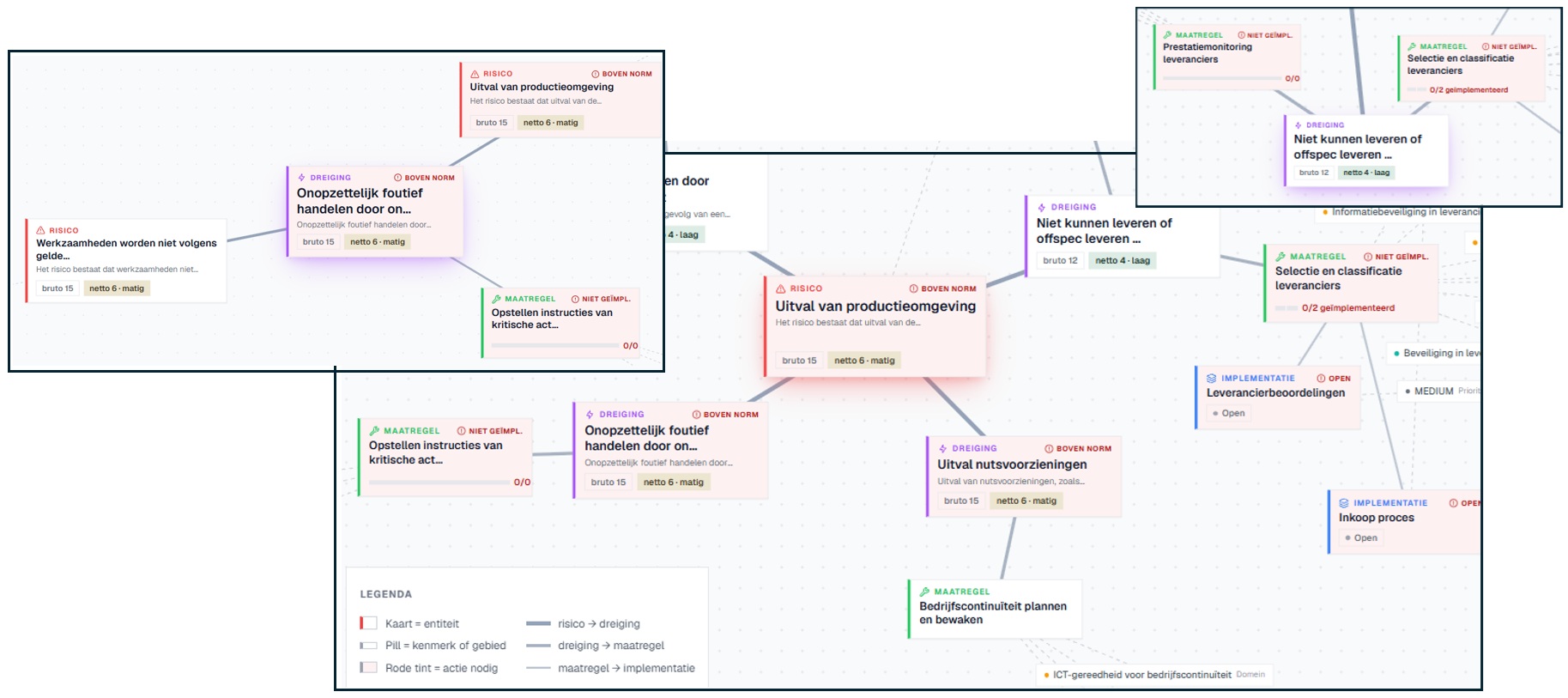
 

AI gereed context


Want to know what a management system platform can do?
Just for fun, set up our cloud solution in 60 seconds as a test, software tool for management systems: documentation, risk analysis, notifications, audits, supplier assessments, etc. And look for the differences with your current way of working ...