kms software


KMS software - ISO 9001

The ISO 9001:2026 differences compared to ISO 9001:2015 reflect a clear modernization of the quality management system. The new version recognizes that organizations operate in a digital and rapidly changing environment. Where the previous standard mainly emphasized process control, the new one focuses on agility and continuous adaptation. The ISO 9001:2026 differences show that risk thinking is being expanded to include opportunity management to stimulate innovation. Data integrity and information management are given a more prominent place as a foundation for quality assurance. Leadership is not only linked to policy, but also to culture and ethical decision-making. The requirements for context analysis have been deepened, so that organizations can better respond to social and technological developments. The standard encourages integration with sustainability and social responsibility. Customer satisfaction is interpreted more broadly as value creation and customer experience. 

In contrast to the 2015 version, more emphasis is placed on knowledge management and learning organizations. Digital technology and automation are seen as indispensable parts of quality management. The use of monitoring, reporting and traceability software is explicitly acknowledged. Documentation requirements have been made more flexible and better aligned with document management systems. The language of the standard has been clarified, including the clarification of terms such as "information documented". The ISO 9001:2026 differences make it clear that internal audits need to be applied more strategically. There is more attention for trend analysis, predictive indicators and data-driven decision-making. The management review will have a more future-oriented function, focused on strategic direction. Cooperation in value chains is considered a crucial factor for consistent quality. The role of employees has been strengthened by the emphasis on involvement, competence and knowledge sharing. Organizations are encouraged to see quality as a shared responsibility. The standard recognizes that service is as important as production. Innovation is seen as an essential part of quality improvement. The role of digital tools, including software, supports continuous evaluation and improvement. Transparency and trust are emphasized as pillars of quality. The requirements for supplier management have been expanded with a focus on partnership and risk sharing. An explicit link has been made between quality and sustainability in decision-making. The standard invites us to systematically learn from mistakes instead of just correcting them. Finally, the ISO 9001:2026 differences emphasise that quality in the future is about adaptivity, integrity and value for people and society.


    Standard quality management system  
PDCA circle Paragraph ISO 9001:2026 

Action

Plan 4.1 Insight into the organization and its context

Explicitly include climate change in context analysis and stakeholder expectations.

Update context analysis and stakeholder matrix; Add climate impact.

4.2 Understanding stakeholder needs and expectations
4.3 Determine the scope of the quality management system
4.4 Quality management system
     
5.1 Leadership and commitment

Strengthened focus on quality culture, ethical behavior and strategic affiliation.    

Develop and communicate behavioural and cultural policy; Actively involve management.

5.2 Quality Policy
5.3 Roles, responsibilities and powers
     
6.1 Actions to address risks and opportunities

Clear distinction between risks and opportunities; Comprehensive change management.

Review risk registers and amendment procedures; Add opportunity-based goals.

6.2 Quality objectives and the planning to achieve them
6.3 Planning of changes
     
7.1 Resources

Work environment expanded with social, psychological and physical factors.

Expand RI&E and HR policy; Monitor well-being and inclusion.

7.2 Competence
7.3 Awareness
7.4 Communication
7.5 Documented information
Thu 8.1 Operational planning and control

Customer communication expanded with contingency actions; more emphasis on sustainability and recycling. 

Update process instructions and customer communication protocols.

8.2 Requirements for products and services
8.3. Design and development of products and services
8.4 Control of externally delivered processes, products and services
8.5 Production and provision of services
8.6 Release of products and services
8.7 Control of abnormal outputs
       
Check 9.1 Monitoring, measuring, analysing and evaluating

Expansion of customer satisfaction (social media, trends) and management review.  

Use new data channels for feedback; Strengthen trend analysis.

9.2 Internal audits  
9.3 Management review  
       
Act 10.1 Continuous improvement

Focus on breakthrough innovation, digitalization, flexible corrective measures.  

Review improvement policy; Add innovation projects to the improvement cycle.

  10.2 Deviations and corrective actions
       
PDCA circle Paragraph ISO 9001:2026  


In short, the new ISO 9001 strengthens the link between quality management, strategy, culture and future-oriented leadership.

QMS software as a platform

Your QMS - Quality Management System has been around since the 90's. First as pApieren manual for all department managers, far too detailed because everyone had recorded all their activities. Later they became digital PDF documents on the central disk. Word documents were provided by the authors and they made the PDFs. But everything is still too detailed. Risk-based management on your goals became the new approach. If you know where your risks lie, what your goals are and how you are performing yourself, you have focus. You can focus on the important things and leave out unnecessary ballast in your described management system, the old 'handbook'. You will link the described management system with the registrations obtained.
What used to be your (quality) handbook is now a management system platform. More comprehensive: quality, safety, environment, information security, .. It is an integrated environment for the described processes, the risk analysis with control measures, all workflow processes and last but not least the performance - the dashboard.


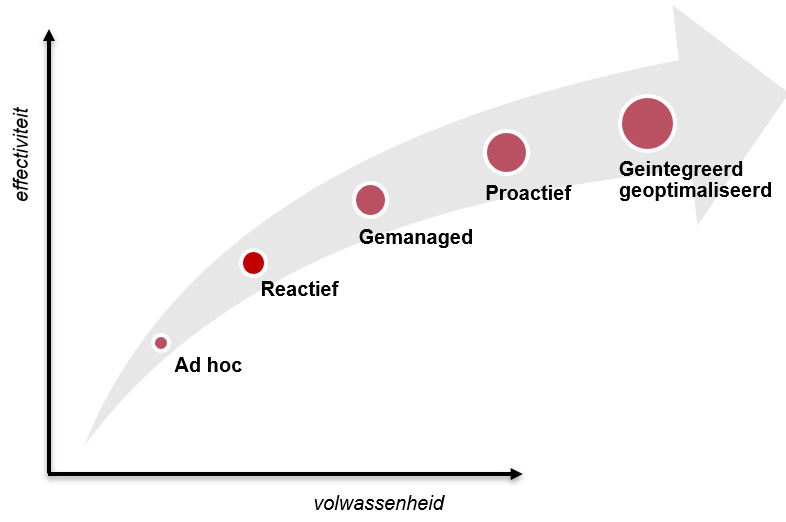
Management system - the maturity stages

Good to know where you stand. The stages of a management system can be described in a number of steps:

  1. Ad hoc
    The understanding of quality management is limited. The quality control of processes is fragmented and problems are widely ignored. There is a lot of ignorance in terms of quality and there is a belief that everything is good. Formally, there are no responsibilities and accountability is not given. Documentation of processes and practices is limited and often outdated. Communication by e-mail and access to quality data and documentation is difficult.
    Tooling: We have already passed this stage.
     
  2. Reactive
    In addition to the quality manager, only a limited number of people are involved in quality management. Quality data is collected in a limited way, usually in separate spreadsheets. Users wait for problems to occur and only then react. Important quality problems are recorded, but not yet sufficiently analyzed to prevent recurrence. There is no integration yet.
    Tooling: A simple quality system for a limited number of people
     
  3. Managed
    Quality management is important throughout the organization, not just for the quality manager. Audits and controls are carried out regularly. KPIs have been introduced and are being steered accordingly. Ownership and responsibilities have been established. 
    Tooling: Version management active, revision rolled out, navigation structures, audit system, registration, checklist ISO9001
     
  4. Proactive
    Quality data is available and accessible throughout the organization. Working methods are up-to-date and laid down in a practical way and also accessible throughout the organization. Problems are recognized and analyzed. Actions are identified and implemented to prevent recurrence. 
    Tooling: Monitoring the use of the management system, reports; incident – > problem, 5W's / 8D, risk process, various workflowsfor checklists, assessments, approvals
     
  5. Integrated and optimized.
    Quality management is a spearhead and a value within the organization. A full process integration supports proactive, risk-based quality decisions. Quality data is correlated with each other, if necessary with artificial intelligence. Collaboration is the key to success to drive positive business and customer outcomes. 
    Tooling: Integrated environment, knowledge base, risk analysis at relevant places/activities, risk carousel, quality calendar, FOBO  analyses, dashboards 

    concept kwaliteitssysteem


Features

A management system is broad in scope: the description of the processes versus the operational implementation. In fact, the well-known slogan: 'Say what you do and do what you say.' A management system is therefore made up of various components: the descriptive part with document management and references to required standard items, the risk overview including risk treatment plan and then all related control processes (handling deviations, audits, complaints procedure, check operational excellence, ..).

An overview of 'standard' functionalities of a mature KMS software:

Navigation / Search
  • Index of all documents
  • Overviews per function, process, standard item, ..
  • My documents, which I have something to do with
  • Last consulted by me
  • Trending documents within the organization
  • Recently searched within the organization
  • Full text search with filtering and search suggestions
Workflow control
  • Workflow processes for review, authorization, modification
  • Self-definable workflow if required
  • Read receipt if registration is important (e.g. safety instructions)
  • Quality calendar to structure activities
Risk-based
  • Overview of threats, risks with classification
  • Risk mitigation controls
  • Assessment of the effectiveness of operational measures
Integration
  • Bringing together 'say what you do' and 'do what you say'
  • Documentation and registration in a
  • One platform as access, but linked to other environments
  • Access from different devices: desktop, tablet, mobile
Expandable
  • Self-definable forms
  • Multiple applications within the same platform
  • For every work area, activity and own working environment
Monitoring
  • Consultations by document, by type, by period
  • Not found, but searched for
  • Never used documents
  • Knowing what is being looked at
  • Self-definable graphs
  • Personalized widgets
  • Registering weaknesses and specifically monitoring them
Chain / Mobile
  • For customers, who have to 'watch'
  • For subcontractors who are required to read instructions (mandatory)
  • Using corporate documents together
  • At the project location, on your phone
  • At the client's bedside, on your tablet


Interested in KMS software?
Just for fun, set up our platform in 60 seconds as a test, KMS software for adult management systems: documentation, risk analysis, complaints, problem reports, audits, supplier management, ... And look for the differences with your current way of working ...


 Metaware platform

 Characteristic

  • Fully integrated and modular platform for documents, risks, complaints, improvements, audits
  • Immediately deployable SAAS sovereign cloud software
  • Supports common quality standards such as ISO 9001 with the PDCA cycle

 Motivation

  • Overall picture of 'quality manual' versus checks, inspections, audits
  • Proven compliance
  • Lower maintenance burden

Decision factor

  • High ease of use through visual navigation and clear interfaces
  • Friendly licensing model based on core users and combination discounts


Demo systems:

Automatically log in to one of the demo systems and experience how it works:

ISO 9001 - Quality and risk management 

HKZ - Quality Care

VCA - Safety 

ISO 27001 - Information Security 

BIO - Government Information Security Baseline 

NEN 7510 - Information security